







Spanish Congress Rejects Vox Proposal to Ban Islamic Veil in Public Spaces
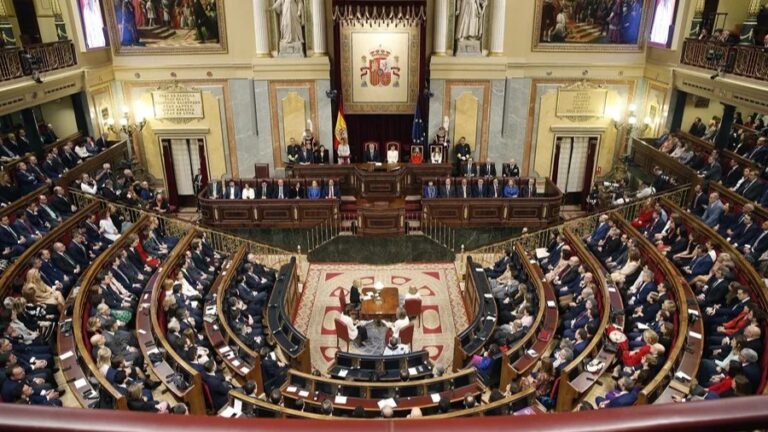
(FILE) Spanish Congress of Deputies. Photo: EFE.
February 18, 2026 Hour: 5:57 am
🔗 Comparte este artículo
Spain’s Congress of Deputies rejected on Tuesday, February 17, a Vox-proposed ban on the niqab and burqa in public spaces by a vote of 177 to 170.
The Governing Coalition and its left-wing partners managed to block the far-right proposal, also backed by the Popular Party (PP, in Spanish) and the regionalist UPN.
RELATED: Spain’s Doctors Strike Over Statute Reform Continues
According to the text presented by Vox last November, the use of garments such as the niqab or burqa has a “very clear implication of eradicating the personal identity of women from collective life” and of “submission to men,” in addition to representing “a serious security risk.”
The legislation also proposed including an article in the Penal Code to punish with up to three years in prison those who supposedly impose “violently, through intimidation or any form of coercion” its use. Likewise, it urged modifying the law on the rights and freedoms of foreigners in Spain and their social integration to provide for their expulsion from Spanish territory if they commit a serious infraction.
Finally, it suggested that the citizen security protection law include wearing a niqab or burqa as a minor infraction.
During the debate, Vox deputy Blanca Armario framed the burqa as a “textile dungeon” and the use of this garment as a “practice incompatible with the fundamental values of Europe.”
From the ruling Spanish Socialist Workers’ Party (PSOE), Deputy Andrea Fernández warned that “mixing crime with Islam has nothing to do with the dignity of women, but it does have a lot to do with xenophobia and the polarization they seek to bring to Spanish society.” However, she noted that the garments are rooted in “misogynistic logic.”
European countries such as Belgium, France, Switzerland, Denmark, and Bulgaria have laws that prohibit the total covering of the face in public spaces, often citing security or the promotion of equality values between men and women.
Additionally, others like Germany, the Netherlands, Austria, and Norway partially restrict the use of the full Islamic veil in certain areas such as schools, hospitals, or while driving.
Author: Victor Miranda
Source: agencies